
Maintaining crystal-clear water in an above-ground pool requires consistent effort.
Leaves, dirt, pollen, and algae spores find their way into the water regardless of pool type.
While manual vacuuming gets the job done, automatic pool cleaners save time and reduce the physical labor involved in weekly maintenance.
Choosing the right system depends on your pool size, budget, and how much automation you want.
Above-ground pools benefit from automated cleaning just as much as in-ground pools do.
Without a cleaner, debris settles on the floor and walls, creating an environment where algae can thrive.
Automatic cleaners remove this debris regularly, reducing the strain on your pump and filter system.
They also help maintain better water circulation, which improves chemical distribution and overall water quality.
Understanding the Three Main Types of Pool Cleaners
Robotic Pool Cleaners
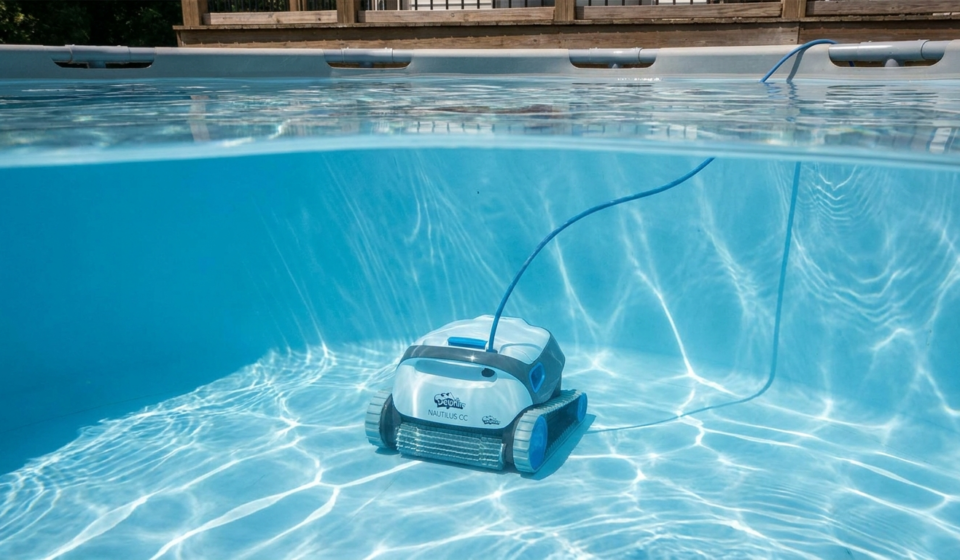
Robotic cleaners are self-contained units that run independently of your pool filtration system. They have their own motor, pump, and filter bag.
You simply place the unit in the water, plug it in, and let it work.
Because they do not rely on your pool pump, you can clean your pool while the main filter system is off.
This reduces energy consumption and wear on your primary equipment.
Robotic units typically feature scrubbing brushes, powerful suction, and fine-filter cartridges. Many models can climb walls and scrub the waterline. They are the most expensive option upfront but offer the highest level of convenience and energy savings over time.
Pressure-Side Cleaners
Pressure-side cleaners connect to your pool return jet.
They use the water pressure from your pump to propel themselves around the pool.
These cleaners have their own mesh filter bag, so debris never passes through your main filter system.
This protects your pump and filter from potential damage caused by rocks or large debris.
Pressure-side models are generally easier to repair than robotic units because they have fewer complex components.
They require your pump to be running during operation, which means they do not save energy the way robotic cleaners do.
However, they offer a solid middle ground between cost and performance.
Suction-Side Cleaners
Suction-side cleaners attach directly to your pool skimmer line. They use the suction power of your pool pump to vacuum debris as they move across the floor. These cleaners are the most affordable option and work similarly to a manual vacuum but with automatic movement.
The main drawback of suction-side cleaners is that all debris passes through your filter system.
If the cleaner picks up a rock or hard object, it can cause damage to your pump or filter.
These units are best suited for pools with minimal large debris and for owners who do not mind occasional filter maintenance.
Corded vs. Cordless: Key Considerations
When shopping for a robotic pool cleaner, one of the first decisions is whether to choose a corded or cordless model. Cordless units offer the appeal of no cords in the water, but they come with significant trade-offs.
Corded robotic cleaners draw continuous power from an outlet.
This allows them to maintain strong suction throughout the entire cleaning cycle.
Most corded models deliver between 4,000 and 4,500 gallons per hour of suction, which is three to four times more than typical cordless units.
They can climb walls, scrub waterlines, and pass over debris without losing power.
Cordless models run on rechargeable lithium-ion batteries.
While convenient in theory, they require frequent recharging and often lose suction as the battery drains.
Many cordless units need to be pulled out of the pool after every cycle for charging, which adds more hands-on time than most owners expect.
For above-ground pool owners who want true automation, corded models are generally the more reliable choice.
Key Features to Look For
Filtration Quality
The filter is the heart of any pool cleaner. Standard mesh filters capture leaves, twigs, and visible debris.
High-performance filters, often called NanoFilters, trap microscopic particles such as silt, dust, pollen, and algae spores.
Cleaners with finer filtration produce noticeably clearer water and reduce the need for additional chemical treatments.
Suction Power
Suction power directly affects cleaning performance. A cleaner with higher gallons-per-hour rating will pick up debris faster and more effectively. For above-ground pools, look for models that maintain consistent suction throughout the cycle rather than units that fade partway through.
Automation Features
Weekly timers allow you to schedule cleaning cycles in advance. Instead of manually starting the cleaner each day, you set a program and the unit runs automatically. This feature is especially useful for maintaining consistent water quality with minimal effort.
When evaluating your options, it helps to compare models side by side. A reliable resource for this is the best above ground pool cleaner guide, which breaks down the top-performing units based on real-world testing and key specifications.
Making the Right Choice for Your Pool
The best cleaner for your above-ground pool depends on your priorities.
If energy savings and full automation matter most, a robotic corded model with fine filtration and a weekly timer is the strongest option.
If budget is the primary concern, a suction-side cleaner can keep your pool floor clean at a lower upfront cost.
Consider the size of your pool, the type of debris it typically collects, and how much time you want to spend on maintenance.
No single cleaner works perfectly for every situation, but understanding the differences between robotic, pressure-side, and suction-side systems helps narrow the field.
With the right choice, you can spend less time cleaning and more time enjoying your pool.